
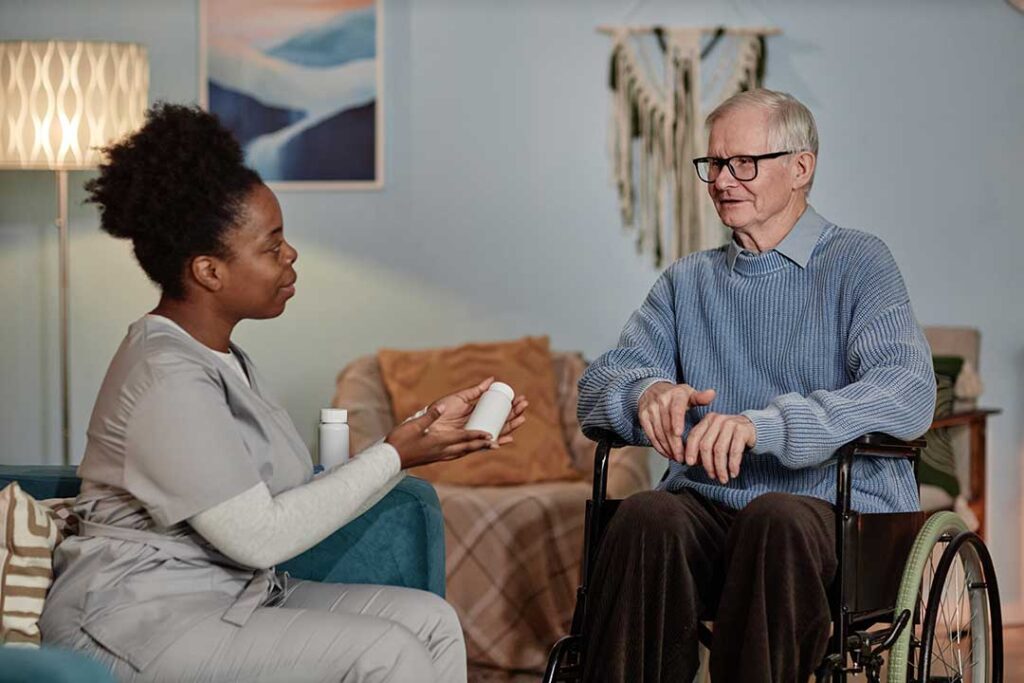
What do assisted living staff do each day?
In North Braddock, PA, assisted living staff generally help residents manage everyday activities, stay safe, follow health routines, and remain involved in decisions about their lives. The level of support depends on each resident’s assessment, service plan, preferences, and changing needs.
Assisted living is residential care rather than a hospital or nursing facility. In Pennsylvania, assisted living residences are licensed by the Department of Human Services and must meet state requirements involving staffing, training, resident health, personal care, nutrition, fire safety, and emergency procedures. ([pa.gov](https://www.pa.gov/agencies/dhs/resources/aging-physical-disabilities/personal-care-homes?utm_source=openai))
Staff support may include:
- Bathing, dressing, grooming, and toileting
- Moving safely between a bed, chair, and bathroom
- Eating, drinking, and following a prescribed diet
- Medication reminders, assistance, or administration as allowed by regulation
- Scheduling medical appointments and arranging transportation
- Laundry, room organization, and care of personal belongings
- Social, recreational, and wellness activities
- Monitoring changes in health, mood, mobility, or behavior
The purpose is not to take over every task. Good assisted living support helps a resident do as much as possible independently while providing help where safety or ability has changed.
How is support matched to an individual resident?
Staff begin with an assessment of the resident’s physical, cognitive, emotional, and daily living needs. The residence then uses that information to create a service plan describing the assistance, supervision, and health-related services the resident requires.
A resident who needs help putting on compression stockings may need very different support from someone who needs reminders to use a walker, assistance with meals, or supervision because of memory loss. Plans should reflect those differences rather than treating every resident the same.
Support can also change. A fall, illness, weight loss, medication change, worsening arthritis, or increased confusion may signal that the plan needs to be reviewed. Pennsylvania assisted living rules address resident assessments, medical evaluations, service needs, and additional staffing based on those needs. ([pacodeandbulletin.gov](https://www.pacodeandbulletin.gov/secure/pacode/data/055/chapter2800/chap2800toc.html?utm_source=openai))
Residents and families can ask:
- What tasks will staff assist with?
- Which tasks is the resident expected to do independently?
- How often is the service plan reviewed?
- Who should be told about a change in condition?
- What happens if care needs increase?
Do staff provide medical care?
Assisted living staff may support health routines, but an assisted living residence is not the same as a nursing home or hospital. Pennsylvania describes assisted living residences as residential settings that may provide personal care, supervision, and supplemental health care services, while nursing homes are licensed medical facilities under a different regulatory system. ([pa.gov](https://www.pa.gov/agencies/dhs/resources/aging-physical-disabilities/personal-care-homes/personal-care-home-faq?utm_source=openai))
Depending on the residence and the resident’s needs, staff may:
- Observe and report symptoms
- Help arrange physician or therapy visits
- Assist with prescribed treatments within their training and authority
- Coordinate with nurses, physicians, pharmacies, home health agencies, or other providers
- Keep records of care, medications, incidents, and changes in condition
Staff should not diagnose a new medical problem or change a prescription on their own. A sudden change—such as unusual sleepiness, shortness of breath, repeated vomiting, new weakness, or a fall—may require prompt medical evaluation.
Families should also ask whether nursing services are available on-site, provided at certain times, or arranged through outside health care professionals. The answer can vary by residence and by the resident’s service package.
How do staff help with medications?
Medication support ranges from reminders to more direct assistance. A resident who can safely manage medication may only need a reminder or help opening a container. Another resident may need trained staff to administer medication according to the prescription and the residence’s procedures.
Medication-related support may include:
- Maintaining an accurate medication list
- Providing medications at scheduled times
- Observing whether medication was taken
- Recording administration or refusals
- Reporting side effects, missed doses, or medication errors
- Coordinating questions with the prescribing clinician or pharmacy
Pennsylvania regulations include requirements related to medication assistance, medication administration training, documentation, and resident health care. The exact duties assigned to a staff member depend on training, authorization, and the residence’s policies. ([pa.gov](https://www.pa.gov/agencies/dhs/resources/aging-physical-disabilities/personal-care-homes?utm_source=openai))
A common misconception is that staff can automatically give any medication a resident requests. They generally must follow the prescription, medication record, and applicable rules. Over-the-counter products, supplements, creams, and as-needed medications should also be discussed with the residence.

How do staff support safety and mobility?
Safety support often involves prevention rather than constant monitoring. Staff may check that hallways are clear, encourage appropriate footwear, remind residents to use mobility equipment, and provide assistance during transfers or nighttime bathroom trips.
In an older housing community, seasonal conditions can affect routines. Snow, ice, wet entryways, limited daylight, and cold temperatures may make travel and outdoor activities more difficult during winter. Staff may respond by checking walkways, adjusting activity plans, helping residents dress appropriately, and watching for changes in balance or mobility.
Safety support should still respect dignity. A resident should not be restricted from ordinary activities simply because staff are concerned. The goal is to identify reasonable support, explain risks clearly, and include the resident in decisions whenever possible.
Emergency preparation is another part of staff responsibility. Assisted living regulations address evacuation, emergency planning, fire safety, and the ability to provide care safely during unusual events. ([pa.gov](https://www.pa.gov/agencies/dhs/resources/aging-physical-disabilities/personal-care-homes?utm_source=openai))
How do staff support emotional well-being?
Emotional support is part of daily care, not an optional extra. Staff may greet residents by name, listen to concerns, encourage participation, notice withdrawal, and help maintain familiar routines.
Support can be especially meaningful after a move, illness, loss of independence, or change in family circumstances. Staff may help a resident:
- Find activities that match personal interests
- Stay connected with family and friends
- Participate in meals or group programs
- Maintain cultural, spiritual, or personal routines
- Adjust to changes in memory, hearing, vision, or mobility
Residents may not always describe loneliness or depression directly. Spending more time alone, eating less, losing interest in usual activities, or appearing unusually irritable can be useful observations for staff and family to discuss with a health care provider.
What should families look for in staff interactions?
Respectful communication is one of the clearest signs of good support. Staff should explain what they are doing, protect privacy, listen to preferences, and avoid speaking about a resident as if the resident is not present.
During a visit, families can observe whether staff:
- Knock before entering rooms
- Use calm and understandable language
- Offer choices instead of giving unnecessary commands
- Respond to call requests within a reasonable period
- Notice residents who need help
- Document and communicate changes in condition
- Encourage independence rather than creating avoidable dependence
Pennsylvania advises people evaluating a residence to ask about staff training and qualifications and to observe how staff interact with residents at different times of day. ([pa.gov](https://www.pa.gov/agencies/dhs/resources/aging-physical-disabilities/personal-care-homes?utm_source=openai))
What if a resident’s needs become greater?
Assisted living may support residents as needs change, but it cannot meet every level of medical or behavioral care. If a resident develops complex medical needs, repeated falls, severe swallowing problems, or a need for continuous skilled nursing, the residence may reassess whether it can safely provide the required care.
The appropriate next step is usually a care-plan review involving the resident, family or representative, residence staff, and relevant health care professionals. The discussion should address what services are available, what additional services can be arranged, and what limits apply.
Residents and families have the right to ask questions about care, records, medications, staffing, incidents, service-plan changes, and complaint procedures. In Pennsylvania, assisted living residences must be licensed, and the Department of Human Services conducts inspections and investigates complaints and unusual incidents. ([pa.gov](https://www.pa.gov/agencies/dhs/resources/aging-physical-disabilities/personal-care-homes?utm_source=openai))
